
Mackinac County Court Arrest Path
In Mackinac County, court records after a jail arrest usually follow a clear local path. The arrest may be made by the Mackinac County Sheriff's Office, St. Ignace Police Department, Mackinac Island Police Department, Michigan State Police, or another authorized agency. The Mackinac County Sheriff's Office, led by Sheriff Edward M. Wilk, operates the local jail channel for custody questions. After arrest and booking, the officer submits reports, records, witness statements, and a charge or warrant request to the Mackinac County Prosecutor. The prosecutor reviews probable cause and decides whether a complaint should be filed in court.
The jail record and the court record answer different questions. The jail side shows current custody, booking, release, or transfer information, so custody checks belong with Mackinac County jail inmate records. The court side shows the formal charge, case number, hearing dates, bond actions, pleas, disposition, and sentencing. Booking photos are also a separate topic, and the research found no official county mugshot gallery. Booking-photo access belongs with the Mackinac County jail mugshots process.
Find Mackinac County Court Records
The main online court lookup path is MiCOURT for Mackinac County 92nd District Court, which is linked from the 92nd District Court page. District Court handles misdemeanor arraignments and sentencing where punishment does not exceed one year in jail, and it also conducts felony preliminary examinations. Once the prosecutor files a complaint, the District Court case is the best public starting point for court records after a jail arrest.
The MiCOURT static source did not expose every form control, so hidden labels should not be guessed. Use the Mackinac District Court redirect or the statewide MiCOURT Case Search portal and follow the prompts that appear on screen.
| Search Area | Use | Notes |
|---|---|---|
| Court selection | Choose or open Mackinac 92nd District Court | The county court page links a Mackinac District redirect. |
| Party name | Search by defendant name when available | Use full legal name when known, because nicknames may not match court records. |
| Case number | Search a known court case | This is often more precise after arraignment or clerk contact. |
| Case detail | Review charges, hearings, and status | Read each count separately because charges can change. |
The official 11th Circuit Court page matters once a felony moves beyond District Court. The Circuit Court has felony criminal jurisdiction, serious misdemeanor jurisdiction, and appeal jurisdiction. The County Clerk maintains Circuit Court records, so felony files that have been bound over may require clerk contact instead of only a District Court search.
For the court-records-after-arrest workflow, move in this order: confirm custody if needed, check MiCOURT for the filed District Court case, then use Circuit Court or the County Clerk if the felony has moved forward.
The Mackinac District Court MiCOURT entry shows the public case-search path used after a filing exists.
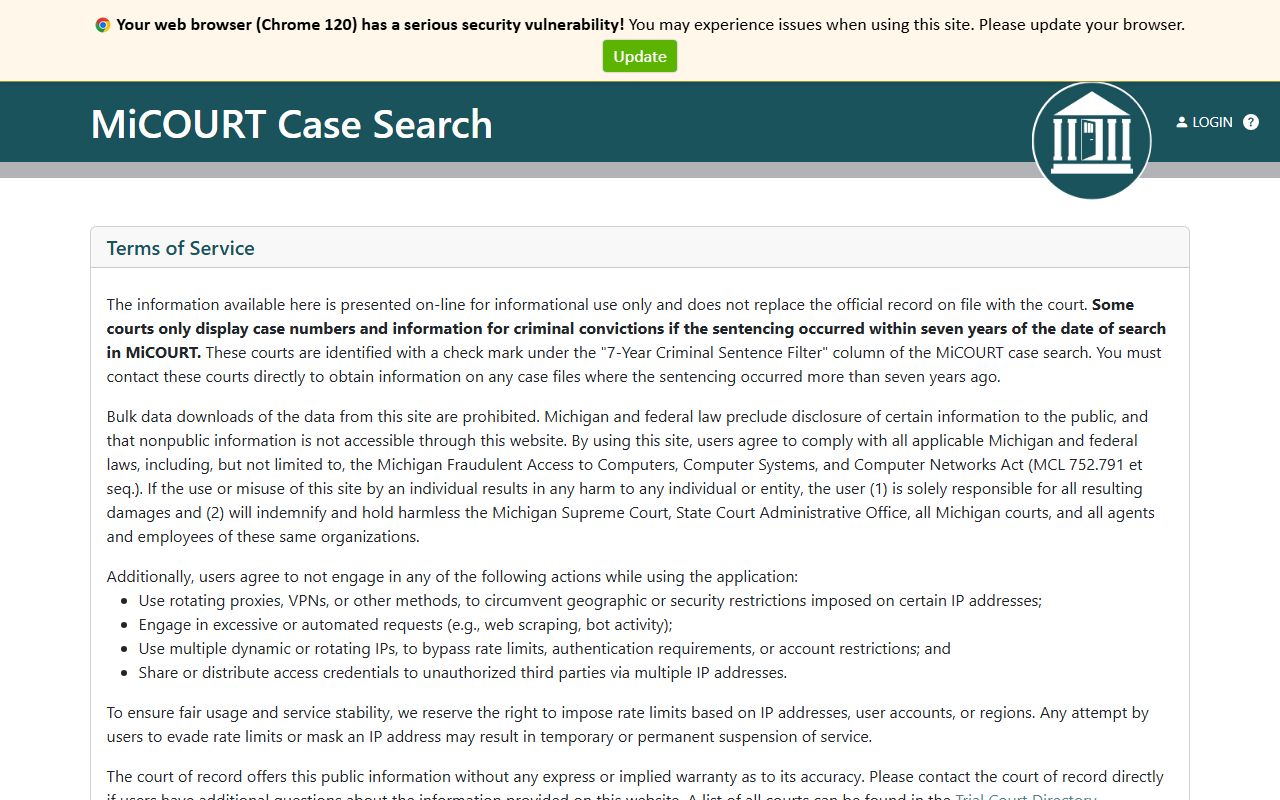
That portal is for court records and case status, not a live jail roster or booking-photo feed.
Mackinac County Court Charge Records
The prosecutor's process page explains why a jail arrest does not always match the final court charge. Police can arrest on the spot when a crime occurs in an officer's presence, or when probable cause supports certain misdemeanors or any felony. The officer later sends a request to the Prosecuting Attorney. If the prosecutor finds probable cause, a complaint may be issued and filed in District Court. A judge or magistrate signs the warrant that brings the defendant before the court when needed.
| Document | Where It Fits | Mackinac County Use |
|---|---|---|
| Complaint | Initial charging paper in District Court | The prosecutor page identifies the complaint as the charging document at District Court arraignment. |
| Information | Circuit Court felony charging document | After felony bindover, Circuit Court arraignment gives formal notice through an Information. |
| Indictment | Grand jury charging document | No county source identified a routine local indictment portal; do not assume one exists. |
A complaint may include one charge, several counts, or charges that later change. The court record is where those changes become visible. A jail booking reason can remain useful for intake context, but the formal case record controls what the court is processing.
Mackinac County Court Arrest Arraignment
District Court arraignment is the first court appearance for both misdemeanor and felony cases. The defendant is told the charges, maximum penalty, constitutional rights, and bond conditions. The 92nd District Court page says that court sets and accepts bail for misdemeanors within its jurisdiction and conducts preliminary examinations in felony cases. Bond is decided at arraignment in almost every case, but release can still depend on the defendant's ability to post the required amount and comply with any conditions.
Misdemeanor cases stay in District Court unless another rule applies. At misdemeanor arraignment, the defendant may plead guilty, not guilty, or stand mute, which is treated as not guilty. A guilty or no-contest plea may lead to sentencing right away or to a later date. A not-guilty path usually moves to a pretrial conference between the prosecutor and defense side.
Felony cases start in District Court but do not end there if probable cause is found. At felony arraignment, the defendant does not enter a guilty or not-guilty plea. The person is advised of the right to a preliminary examination within 14 days. If probable cause is shown, the case is bound over to Circuit Court. If not, the felony can be dismissed or reduced to a misdemeanor.
Mackinac County Charge Status
Charge status is one of the main reasons to look up Mackinac County court records after an arrest. A charge can be pending at arraignment, amended during review, reduced during plea talks, dismissed for lack of proof, or resolved by plea, verdict, or sentence. Read the case docket and each count instead of relying on a single booking label.
| Status | Plain Meaning | Where to Check |
|---|---|---|
| Pending | The charge has been filed but has not reached final disposition. | District Court or Circuit Court case detail. |
| Amended | The filed charge changed after prosecutor or court action. | Case docket entries and amended charging papers. |
| Reduced | A felony or higher count may have moved to a lower charge. | Pretrial, plea, or preliminary-exam records. |
| Dismissed | The count was dropped or not carried forward. | Disposition line for the count, not the booking record. |
| Bound over | A felony moved from District Court to Circuit Court. | District Court exam result and Circuit Court file. |
Note: A court charge is an accusation until the case ends in a plea, verdict, dismissal, or other final court action.
Mackinac County Bond Records
Bond links the jail arrest to the court file. The prosecutor page says bond is determined at District Court arraignment, and the judge may impose conditions such as no contact with a victim. The sheriff and jail pages link GovPay for cash bond, while the District Court page links GovPay for court financial payments. Confirm the exact payment type before paying, because bond for release is not the same thing as fines, costs, jail housing, booking fees, or tether fees.
| Release Type | How It Works |
|---|---|
| Cash bond | Money paid through an approved court or jail channel to meet release terms. |
| Surety bond | A bail bond business may be involved where allowed and ordered. |
| Personal recognizance | Release on promise to appear and obey conditions, if ordered by the judge. |
| Conditional bond | Release may include no-contact or other conduct limits. |
| No-bond hold | Another warrant, detainer, probation hold, parole hold, federal hold, immigration detainer, or court order may block release. |
If custody status is the main question, call Mackinac County Jail at (906) 643-7325. If bond terms, charge status, or disposition are the issue, the court record is the stronger source.
Mackinac County Arrest Warrants
No official Mackinac County active warrant list, warrant portal, or public warrant search was found in the sheriff, court, or county sources. The local official warrant material comes from the prosecutor's process description. Most cases begin with a warrant request, prosecutor review, a sworn complaint filed in District Court, and a warrant signed by a magistrate or judge.
For a possible warrant arrest, use official channels. Call the jail for custody after an arrest. Use MiCOURT or the 92nd District Court for a filed District Court case. Contact the County Clerk or Circuit Court for felony files after bindover. For written records that are not already posted, use Mackinac County's FOIA process through the County Clerk and FOIA Coordinator.
Mackinac County Court Comparisons
Court records after a jail arrest can be easy to misread because several terms sound final before the case is over. A charge is not a conviction. A sealed record is not always the same as an expunged or set-aside conviction under Michigan law.
| Question | Charge | Conviction |
|---|---|---|
| What it means | An accusation filed or pursued by the prosecutor. | A final result after plea or verdict. |
| Proof level | Probable cause and charging review at early stages. | Proof beyond a reasonable doubt, or a valid plea. |
| Where it appears | Complaint, docket, and hearing records. | Disposition, sentence, and judgment records. |
| Question | Sealed | Expunged or Set Aside |
|---|---|---|
| Public view | Public access is limited by court order or law. | Eligible conviction access is restricted after set-aside action. |
| Michigan route | Depends on the record type and court order. | MCL 780.621 and Michigan Courts form MC 227 provide set-aside context. |
| Practical step | Check the court that controls the record. | Use the court where the conviction occurred and review Michigan Clean Slate information. |
The Michigan FOIA policy statute, MCL 15.231, favors public access to government records. The response statute, MCL 15.235, supports the county's five-business-day response framework. Those rules do not make every court, juvenile, law-enforcement, or sealed record open without limits.